

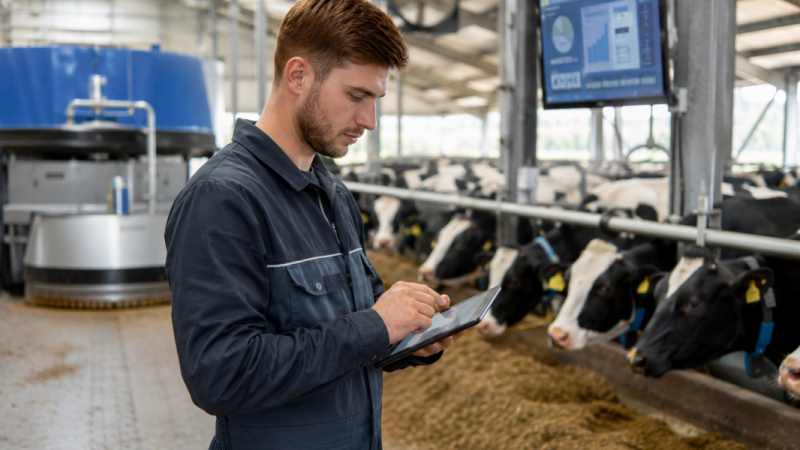
European livestock farming is facing one of its greatest challenges in recent decades: the ageing of producers and the limited number of young people entering the sector. Across many European countries, a large proportion of livestock farms are managed by professionals approaching retirement age, while fewer young people see farming as a viable career path. This situation not only threatens the continuity of thousands of family-run farms, but also the long-term economic and food sustainability of the continent.
A Structural Problem
The difficulty in attracting younger generations stems from a combination of economic, social and cultural factors. Livestock farming requires significant initial investment in facilities, machinery and animals, while operating costs linked to feed, energy and sanitary regulations continue to rise. In addition, the sector is often perceived as demanding, with long working hours and limited work-life balance.
In many rural areas across Europe, there has also been a gradual decline in basic services, educational opportunities and digital connectivity, encouraging young people to move to urban centres. As a result, many family farms disappear due to a lack of succession, accelerating the ageing of the sector and weakening the rural productive network.
Consequences for Europe
The lack of generational renewal has direct implications for European food production. The closure of farms reduces local production capacity and increases dependence on external imports, particularly in a global context marked by geopolitical instability and pressure on food markets.
Furthermore, the disappearance of small and medium-sized farms contributes to greater concentration of production within large industrial groups, reshaping the economic and social balance of many regions. The abandonment of livestock farming also fuels rural depopulation and leads to the loss of technical knowledge accumulated over generations.
Europe therefore faces a strategic challenge: ensuring the continuity of the livestock sector while maintaining high standards of sustainability, animal welfare and food safety.
Technology as the Opportunity
Against this backdrop, technological modernisation has emerged as one of the sector’s main opportunities for revitalisation. The integration of automation, digitalisation and artificial intelligence is transforming European livestock farming.
Today, many farms operate with automated feeding systems, health-monitoring sensors, robotic milking equipment and digital management platforms. These technologies help reduce physical workload, optimise resources and improve operational efficiency.
So-called “precision livestock farming” not only boosts productivity, but also appeals to younger generations with technical training and entrepreneurial ambitions. Digitalisation is gradually changing the traditional image of livestock farming, positioning it as an increasingly innovative and professional industry.
What the CAP Is Doing
The Common Agricultural Policy (CAP) has identified generational renewal as a priority for the future of Europe’s agricultural and livestock sectors. In recent years, the European Union has introduced targeted support for young farmers, including financing schemes, technical training programmes and incentives for farm modernisation.
The aim is to facilitate access to the profession and reduce the economic barriers faced by those wishing to enter the sector. At the same time, the CAP seeks to encourage more sustainable and competitive production models through support for technological and rural innovation projects.
However, many experts agree that current measures are still insufficient in view of the scale of the challenge, particularly in regions affected by severe rural depopulation and low farm profitability.
New Profiles of Young Livestock Farmers
The new generation of European livestock farmers differs significantly from previous ones. It is increasingly common to find young professionals with university education, technological expertise and strong business-oriented approaches managing modern and highly specialised farms.
Many of these new profiles prioritise sustainability, energy efficiency, animal welfare and digitalisation as core pillars of their production models. Interest is also growing in differentiated products, short supply chains and value-added production systems.
This generational shift represents not only a change of people, but also a profound transformation in the way livestock farming is understood. The future of the sector will largely depend on its ability to offer profitability, quality of life and innovation to younger generations.
Añadir comentario
Comentarios